
Curatorial: Rhinolophus Sinicus
In One Breath
Lenguh Para Facist
Nindityo Adi Purnama Art Work
by LIR (Mira Asriningtyas & Dito Yuwono)
On the day when we were writing this curatorial essay, the World Health Organisation had just declared the global health emergency status of Covid-19 is over (1). After more than two years, we have finally come to terms and live side by side with the continuously mutating virus. When we look back to the year 2020, during the time of crisis, precarity, and collective trauma; it was hard to imagine life after the anthropause(2). It was during that collective long pause too when human activity worldwide was reduced temporarily, giving a much needed moment for the earth to breathe and regenerate. Now, we have finally reached the end of the tunnel.
The pandemic was a deeply personal collective experience. We are all experiencing it together and yet, it leaves personal marks for each and every person in different ways imaginable. We were all living in a historical moment and to keep a personal record of it could also mean being an active part of the history of world civilization. The role of artists and writers is vital here to document these interesting times we are living in for the future.
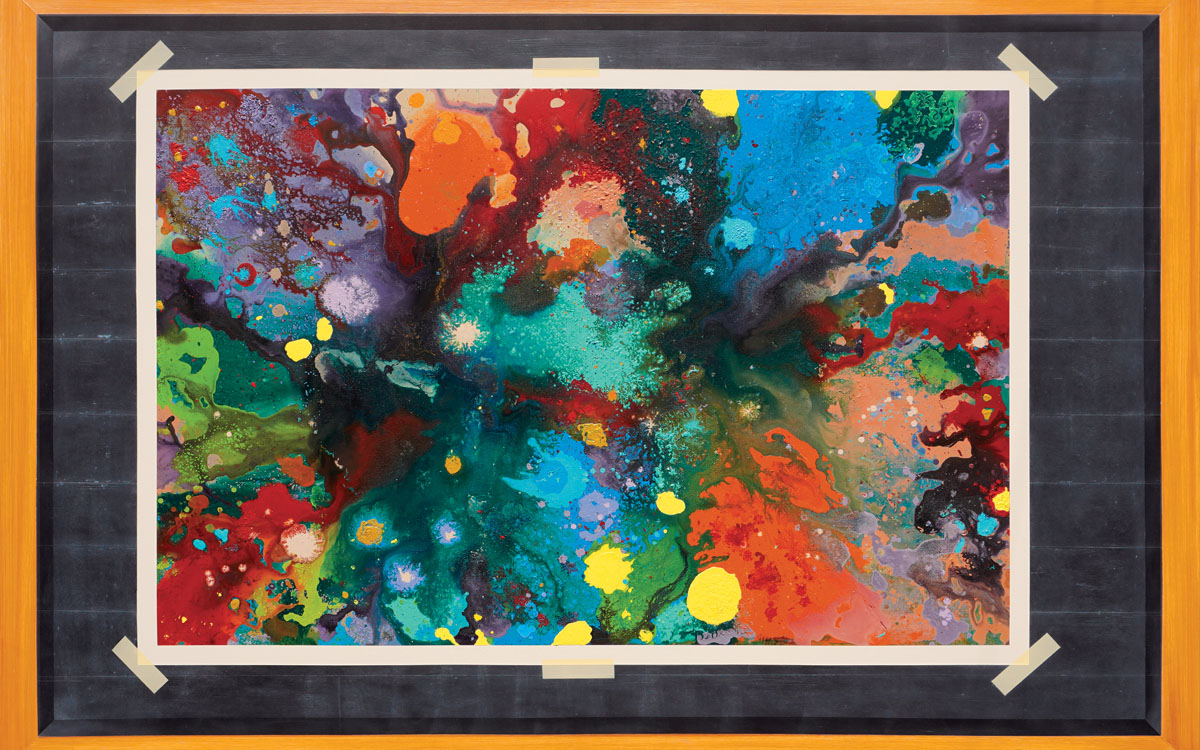
In 2021, Nindityo Adipurnomo started a new series of work as his personal way of keeping records about the pandemic. Titled “Rhinolophus sinicus” (3), the project uses an era-specific medium to recall new embodied gestures that mark the social as well as political impacts of the pandemic. Focusing on exploring the aesthetics of the social phenomena during the pandemic, the artist uses his personal embodied experiences and responses in the face of the ongoing socio-political turmoil. Throughout the process of making the series of works, his notes grow and his readings widen—from the simple gesture of wearing a face mask during the pandemic to the conversation about gender inequalities, biopolitics, climate catastrophe, environmental pollution, humanitarian crises, wars, identity, religion, and territory. Unfortunately, it was not that much of a stretch. The pandemic did resurface and poke at how unsustainable our old ways of life were. It shone a particular spotlight on the ecological crisis and inequalities of the world. A series of installations, titled “Earth Crown #1 & #2” (2022) is his tribute and ode to the earth amidst this madness and crisis of the world.
For a moment, we were all fighting for something on top of the virus: patriarchy, racism, fighting for environmental sustainability, and so on. For a moment, we all dreamed of a better new world after the pandemic: of living more sustainably, leaving the old normal, traveling differently, and being more responsible for how we live our daily life. But, as soon as the pandemic is over, humans rush to live a life as we knew before, air travel surges and the earth is left with more waste. Apparently, even a pandemic of such magnitude can eventually feel like something of a distant past and forgotten times. As the crisis averted, did we let the learning evaporate and rush back to the way we lived before? Within the pandemic year, did we have time to internalize the lessons or even turn them into a revolution?
Nindityo’s observation of the gesture of everyday life during the pandemic started with people’s personal relation to masks and their liberty of how to wear them. Presented in the “Sound of Masker” (2021), this painting composed of colorful masks on canvas is a portrayal of how personal gesture and embodied experience of the citizen changes alongside the government’s requirement to wear masks collectively and en masse. The suggestion kept changing from cloth masks, KN95, to surgical masks combined with cloth mask, and so on. Personally, it was the gesture of using cloth masks at the beginning of the pandemic that formed Nindityo’s relationship with them. Even after he shifted to the surgical and medical-grade mask, he kept the habit of washing and keeping them.
The gouaches, ink. acrylic/charcoal on paper series titled “Leaks in The Jargon of ‘Working from Home’” (2021) notes Indonesian citizens’ obedience in implementing health protocols– from keeping their distance, working from home, to mask-wearing. One phenomenon that caught Nindityo’s attention is the community’s initiative and creativity in anticipating mask supply that did not meet people’s demand during the panic-buying era. This precarious condition triggered a collective solidarity movement of sewing their own cloth mask to distribute and give away– especially to the essential workers and those in need. Alongside the pandemic, a surge of citizen-initiated solidarity movements are popping up; from free masks to providing meals and groceries to those who need them, creating a platform for promoting friend’s business and income redistribution, to lending and hunting for oxygen tubes during the oxygen crisis. The pandemic was a collective trauma that shed light on the inequality of the society– yet, the citizens responded in a way that mutual cooperation and solidarity are flourishing and kept alive: a true spirit of gotong royong.
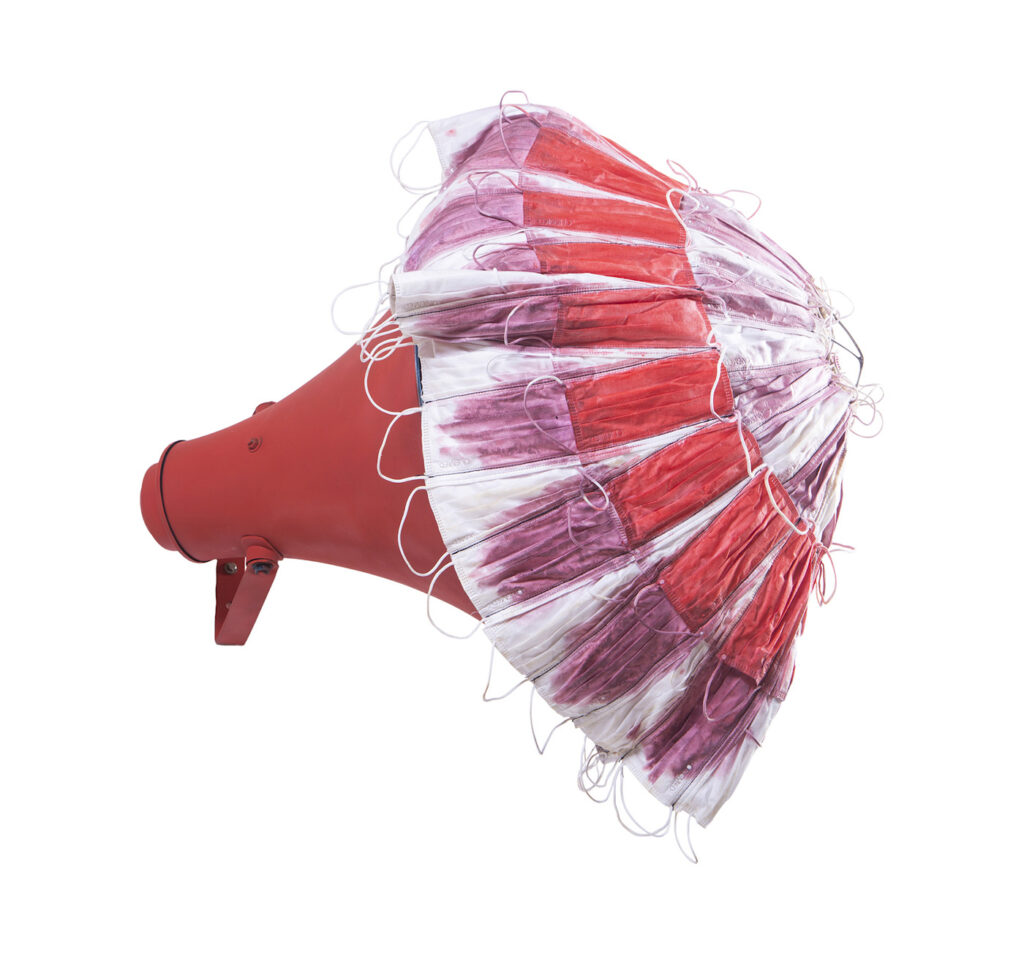
The installation, titled “Lenguh Para Fascist” (2021-2022) consisting of four toa loudspeakers clogged with seams of masks was inspired by the situation where the tightening of health protocols was at its peak. The suggestion to limit physical interaction, the call to wear a two-layer mask outside one’s home and the optimization of screen-based communication shows a number of interesting impressions for the artists. As the economic system shifted toward a more physically-distanced day to day activity; the religious rituals shifted in a way that complied with the health protocols too. The four toa loudspeakers clogged with masks represent the formality of six types of religions and beliefs that are politically recognized in Indonesia and how religious gathering changes during the pandemic.
Moving toward Nindityo’s concern about gender inequalities are the series of paintings, titled “Pandemic and Women’s Garland #1 & #2” (2022) and “Pandemic and Trophy for Men (Men’s Garland)” (2022). Upon pondering on the massive consumption of personal hygiene products, Nindityo started to reflect on the gestures and habits of mask wearers according to their genders. He observes how even though mask-wearing rules are independent of one’s gender; the obedient male mask-wearer around him would instinctively lower his mask when greeting and talking. He wonders if it is true that women were more likely to wear masks properly during the pandemic. Are men less disciplined because wearing masks might threaten their masculine image? Or was it because suddenly, rules and dress codes are imposed on them?
The two series of works, “Rubel Dollar Euro #1 & #2” (2022) are still circling around masculinity and the crisis that eventually leads to war. The first edition of this series consists of a video installation with three carpets of maskers and objects surrounding a video projection. In the video, three male figures are playing as the tension slowly rises and soon it all heated up. The second edition of the series consisted of three smaller size paintings composed of printed masks, gouaches, and acrylic on canvas. The images of three different currencies are small and seemingly insignificant amidst the plain blank space around them.
Finally, the last work “Mono Human Being – The Ballade of Human Emission #b” (2023) is an arrangement of terms that the artist uses arbitrarily to represent his way of expressing the slips and failures of “modernism” and the anthropocentric era. This rattan installation is a broader and holistic contemplation of death—the death of humanity, the metaphoric death of the anthropocentric era, and death as part of the cycle of life—a process of renewal as well as regeneration.
In the process of making this exhibition, the artist found a plethora of bodily experiences that helped him distinguish between masculinity and femininity within himself. This gesture of keeping the mask from getting into the landfill is one of them. It is reinterpreted into artistic format as his act of care. For Nindityo, the most striking sight that keeps popping into his head is the used masks that are scattered on the village streets, absorbing flecks of nameless dirty liquid in gradations of colorful absorption. Later, these surgical masks are no longer considered masks but an era-specific detail of his chosen material to create a painting. Not only experimenting with the medium, he opted for more sustainable options for his work.
Opting for sustainability is part of personal responsibility in the face of the surge of medical waste such as disposable suits, masks, and gloves among others that have overflown our landfill. A study suggested that the Covid-19 pandemic is estimated to generate up to 7,200 tons of medical waste every day (4). At this point, the choice of medium became part of his politics and artistic vocabulary.
As an artist who was formally educated in Rijksakademie, one of the most prominent art academies in the world, with artistic practice spanning more than three decades; Nindityo is fluent in experimentation across mediums to deliver his thesis, observation, and long-term research. His artistic choices became part of his politics and were perfected with meticulous production. His projects are often research-based and grounded in a socio-political context. Every now and then, he would courageously challenge the established pattern of creating his own work. In the “Rhinolophus Sinicus” project, he made an important point that succeeded in demonstrating his expertise in playing with multiple mediums in manifesting his political stance. Each of Nindityo’s works is a fragment of a time-specific phenomenon that is intended to capture layers of problems, presented in a whole rounded discourse, experience, and embodiment of his thorough observations in socio-political complexities at a specific period of time– an important note of a recently passed collective history.
May 5, 2023
1) On May 5, 2023; The World Health Organization declared the worldwide health emergency of covid-19 over. It is now determined that COVID-19 is now an established and ongoing health issue which no longer constitutes a public health emergency of international concern (PHEIC). World Health Organization, “Statement on the Fifteenth Meeting of the International Health Regulations (2005) Emergency Committee Regarding the Coronavirus Disease (COVID-19) Pandemic”, World Health Organization https://www.who.int/news/item/05-05-2023-statement-on-the-fifteenth-meeting-of-the-international-health-regulations-(2005)-emergency-committee-regarding-the-coronavirus-disease-(covid-19)-pandemic (accessed on May 7, 2023).
2) Anthropause, a term coined by Rutz et al, defined as a significant temporary reduction in human activity worldwide, as during a pandemic, that noticeably affects environmental phenomena such as levels of air pollution, the movements of wildlife, and even seismic noise. Rutz, Christian, Matthias-Claudio Loretto, Amanda E. Bates, Sarah C. Davidson, Carlos M. Duarte, Walter Jetz, Mark Johnson, et al. “Covid-19 Lockdown Allows Researchers to Quantify the Effects of Human Activity on Wildlife”, Nature News, Nature Publishing Group, June 22, 2020 https://www.nature.com/articles/s41559-020-1237-z (accessed on May 7, 2023).
3) Knowledge of the origin and reservoir of the coronavirus responsible for the ongoing COVID-19 pandemic is still fragmentary. To date, the closest relatives to SARS-CoV-2 have been detected in Rhinolophus sinicus (the Chinese rufous horseshoe bat) sampled in the Yunnan province, China. Delaune, Deborah, Vibol Hul, Erik A. Karlsson, Alexandre Hassanin, Tey Putita Ou, Artem Baidaliuk, Fabiana Gámbaro, et al. “A Novel SARS-CoV-2 Related Coronavirus in Bats from Cambodia”, Nature News, Nature Publishing Group, November 9, 2021 https://www.nature.com/articles/s41467-021-26809-4 (accessed on May 7, 2023).
4) Anne Trafton MIT News Office, “The Environmental Toll of Disposable Masks”, MIT News, Massachusetts Institute of Technology, https://news.mit.edu/2021/covid-masks-environment-0720 (accessed on May 7, 2023).