31 March 2022
Curatorial: Spreading Seeds of Hopeful Light
by Arif Bagus Prasetyo (Curator of Fine Arts, living in Denpasar)
It’s been two years since the pandemic hit the world. Millions of people lost their lives due to the infections of the cursed virus. Many more lost their jobs and income. Nobody knows when this vicious plague will pass. No one even dares to guarantee that it would ever leave the face of this earth. The road back to a “normal” life seems so far away, it seems endless.
With the world never having recovered from this illness, more bad news arrived. A new war is raging. The Northern Hemisphere is smouldering. The fire threatening to spread everywhere. It could drag the world into the hell of the war which ends all. The scent of global annihilation floats in the air.
The world seems to be gripped by a terrifying dark cloud. In the midst of all the stifling existential uncertainty, hope is like a light which guides the journey of the ark of life in the heart of a stormy ocean. In today’s gloomy world, hope is the sun that life so desperately needs.
Art is able to publish the sun of hope. Art has the power to connect, communicate, transform, and heal. With that power, art constantly conveys the message that hope is always there. Even in works that reveal the saddest of tragedies, art still holds out hope because it gives us beauty. As the world famous painter, Gerhard Richter put it: Art is the highest form of hope.
In his exhibition entitled Seeds of Light, Putu ‘PW’ Winata intends to voice his visions of hope. His latest works are artistic expressions about the spirit of optimism when looking at today’s life which is haunted by anxiety, uncertainty, and confusion. Through art, a medium that is believed to have healing energy, PW spreads a positive message that hope is a light which is faithfully waiting at the end of a dark tunnel. Hope is the sun that surely rises to warm life after a dark night. This optimistic message echoes from the titles of a number of PW’s paintings: “Bersyukur dalam Senja” (Grateful during Dusk), “Manusia dalam Cahaya” (Mankind in the Light), “Sebelum Kau Melihat Cahaya” (Before You See the Light), “Tak Tersentuh Tapi Menerangi” (Untouched But Illuminating), “Bisikan Kedamaian” (Whisper of Peace), etc. Some of the works are even titled “Hope”. PW’s works are like the seeds of light. Light of hope.
Hope is a concept. It is abstract. Hope is not a concrete thing. It takes no form, it cannot be seen. From one art piece to another, PW expresses his creative interpretation of hope by using the language of abstract painting. He paints hope.
PW’s paintings basically does not refer to anything concrete which exists outside the painting itself. PW does not seek to represent the concrete world. He does not “transfer” concrete nature onto his canvas or paper. His paintings shun concreteness. However, by painting hope, PW is paradoxically also close to concreteness. He concretizes something abstract, namely hope. It gives shape to hope. His paintings make hope tangible, it gives hope a form which can be seen.
In his works, PW speaks of hope in an artistic language that celebrates life. His paintings are imbued with a passion for life that overflows and explodes in a vibrant celebration of lines and colors. Dominated by bright colors and strokes or smears of paint that seem to dance in a half trance, on the precarious threshold between consciousness and unconsciousness, PW’s work echoes joie de vivre, the joy that is released.
The field of painting PW is in, is like a stage for a cosmic show that performs an energy dance. Visual elements meet and separate, support and contradict each other. Colors and lines explode and spread, expand and contract, melt and condense. PW’s abstract composition is reminiscent of a cosmic drama which sows the seeds of life in fields of stars or in subatomic grounds.
Guided by intuition, PW orchestrates color and motion into unique visual compositions that feel wild yet controlled, free but measured, random yet structured. The imagery in his paintings seem to convey chaos, but at the same time there is rhythm and association which links our memories to something that is vaguely recognizable: landscapes, trees, clouds, etc. Each art piece is like telling a story about the process of creating something from a chaotic high-energy moment, when wild forces reign. Something whose form was identifiable seemed to be vaguely growing from the chaotic turmoil. There is a process of transformation from an unstable energy realm to a stable material realm.
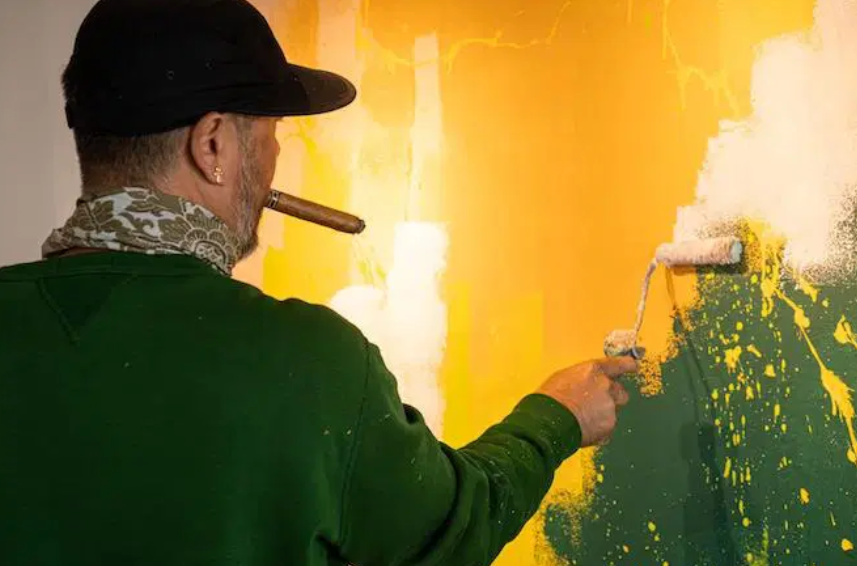
In PW’s creative work, at first is the spontaneity of intuition and emotion. The flow of energy. PW paints expressively. He vents the waves of his soul on canvas or paper. Relying fully on instincts and instantaneous stimuli, he poured all the feelings and emotions that were raging in him.
Borrowing Sigmund Freud’s theory on the division of structure of the human psyche, the expressive character of PW paintings seems to reflect the Id: the primordial part of the mind, an area where Eros (life instinct) and Thanatos (death instinct) reign. The Id is primitive, unrestrained, and emotional. In the world of the Id, there is no logic. There are only innate instincts, sexual desires, desires for aggression, and pent-up desires. The Id is the dark and untraceable side of our personality. It is called chaos, a crater full of bubbling stimuli. “The Id contains energy which it derives from instinct, but it is disorganized and produces no collective will, except for the mere pursuit of satisfaction of instinctual needs which is the subject of the pleasure-seeking principle,” said Freud.
Although infused with Id, PW paintings do not celebrate chaos. In the wilderness of instinctive lines and colors that dominate the painting space, there is almost always a shadow of the Ego, the mental realm which is on a higher level than the Id. The ego is the mostly conscious aspect of personality. Outward perception, inner perception, and intellectual processes are examples of the activities of the Ego. The ego is controlled by the principle of rational reality, expresses itself through language, and is in accordance with social demands. Functioning to synthesize, the Ego controls and represses the chaotic turmoil of the Id energy.
To a certain extent in his creative process, PW seems to hold back some of his instinctive energy to find a form. As a result, in his paintings, faint traces of the ego appear in the form of basic schemas that represent certain figurative identities, such as trees or flowers. It is informal and unstable. Its existence is not steady. The burst of emotional energy often makes the appearance of figurative identities distorted. Sometimes they seem to exist and not exist, arising and drowning in the flow of abstract images that come from emotional impulses.
Although vague, the presence of recognizable forms in the abstract wilderness of PW’s paintings suggests that chaos isn’t everything. Chaos is not the end. On the contrary, chaos always promises order. Darkness always promises light. There is always hope ahead there.
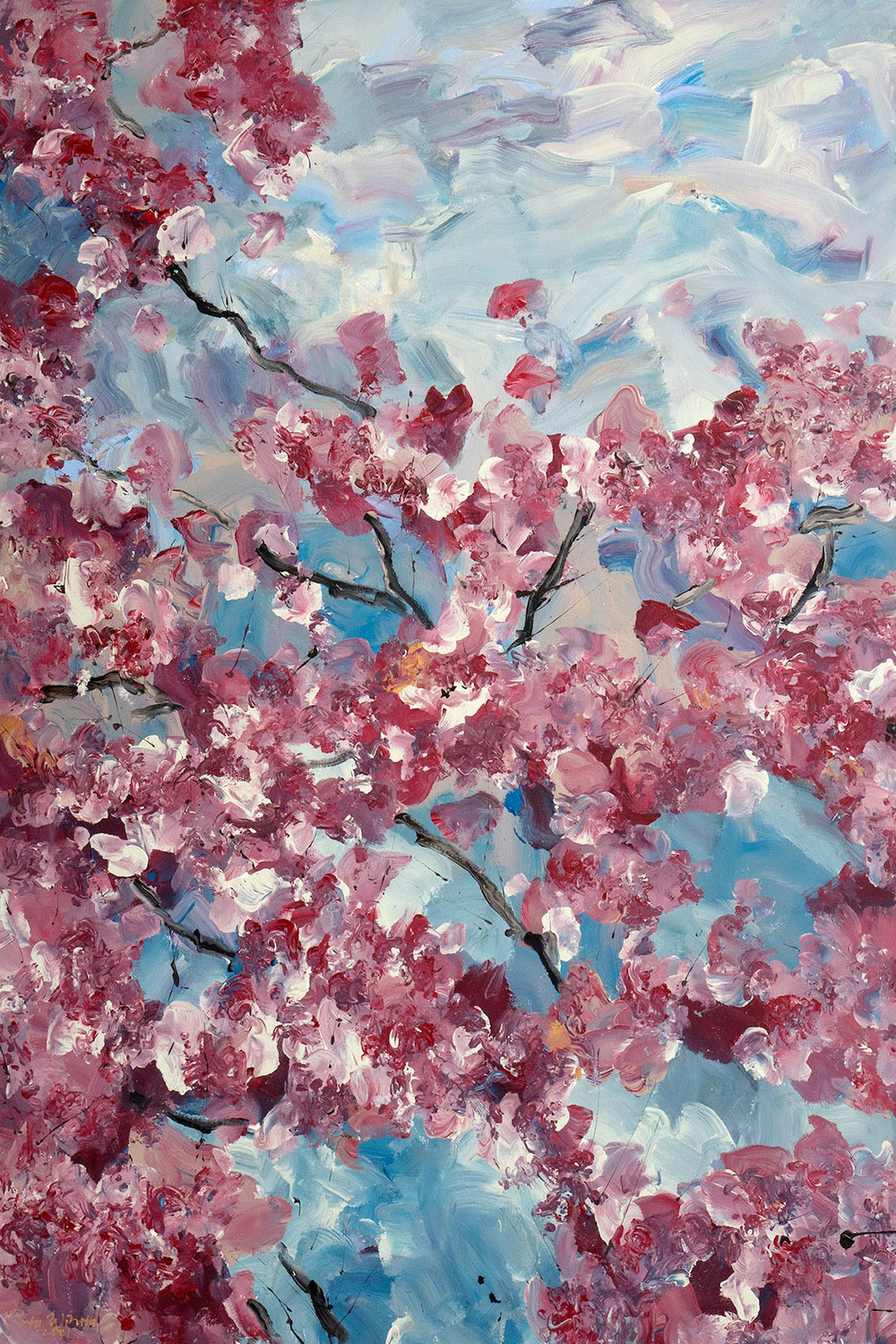
PW creatively bends traditional landscape painting. He reinterpreted Impressionism and Post-Impressionism. Absorb the power of Pointillism and Action Painting. It clashes the desire for representation and the spirit of abstraction. The result is dynamic “landscape” paintings that are unique, fresh, and colorful. The image of natural scenery is clearly displayed in several paintings, such as “Kerinduan” (Longing) and “Sebelum Kau Melihat Cahaya” (Before You See the Light). A number of paintings depict the image of a flower tree against a sky background, such as “1,000 Rasa” (1,000 Feelings) and “Pesona Hati” (Charms of the Heart). Other works also display abstract images that are quite easy to create an impression of the landscape, for example the texture of the land surface, topography, cliffs, fields, waters, etc.
When painting, PW is inspired by nature. However, he did not paint nature. Nature, even memories or impressions of nature, are only a kind of “entrance” for him to explore the depths of his inner world and pour it as a new creation on canvas or paper. Nevertheless, the nature that inspired him did not disappear in abstract paintings that recorded the movement of the artist’s soul. Instead, nature appears in the painting with a completely new face, in all its freshness, as if it had been seen for the first time. Nature seems to be a vision of the highest ideal of beauty for PW. Nature becomes a symbol of creative energy itself.
A number of PW’s works are presented in three dimensions. The “Artwork on Paper” series was done on dented paper and placed in a clear acrylic box. The works of this series specifically raise the theme of the “greenhouse effect”. PW symbolically criticizes modern human behavior which causes the earth to suffer from global warming.
Departing from nature, PW paintings echo things that are essential to nature. His work explores beauty, vitality, tenacity, resilience, regeneration, but also transience, fragility, and decay. Nature has a double face: it is both a blessing and a threat. Precisely because of that, nature gives hope. And just as nature is an inspiration, PW’s work exemplifies belief in the light of hope.