
Curatorial: Fragment by Fragment
Concrete Emotions and Assertive Lines
Cultural labor can be interpreted as a type of labor that produces meanings, leading to the workers’ identification and recognition. In this sense, cultural labor shouldn’t be alienating the workers. Not only identifying the workers, this labor also ties together the creation of a concept and the execution of it. Also, this labor can be categorized as immaterial labor because the workers utilize immaterial things, i.e. creativity and affection to produce or support cultural production.
In addition to creativity and affection, cultural workers retain individuality and autonomy. These distinguish artists and creatives from white-collar workers. Individuality emphasizes a distinctive character of the self that is projected on the work result, and every individual’s work gives a distinctiveness in mass and non-mass products. It also suggests a kind of privilege intrinsic in every creative worker to have control over themselves in working time. Thus, it grants artists and creative workers with autonomy that frees them from a mechanistic, standardized, and scheduled work system. However, individuality also implies a full responsibility of the worker, especially if things go wrong. This raises the notion to employers that they need not pay for their empployee’s social security and health costs. In addition, individuality and autonomy are used by the neoliberal economic system to exploit cultural workers. Creative and cultural workers are trapped to use their personal time to keep working, involving intense affection and emotions. This exploitation happens in vague ways as cultural labor is fueled by the workers’ passion. The concept of individuality, according to McGuigan (2010), leads to today’s paradox work and everyday life, liberating in some ways, and at once harsh and alienating. Individuality is especially pronounced in the world of “creative industry” that allows for “a tantalizing sense of expressivity at the cost of exceptional difficulties in working life – including insecurity, poor pay and conditions…”
Artists, especially visual artists, can also be called cultural labors. They do not only involve immaterial things; they also make use of material works, and very intensively. Considering their immaterial and material burdens, not to mention the individuality that places them as those who must survive to sustain their art, can we call artists part of the vulnerable cultural workers?
This exhibition presented the latest works of two artists, Ika Vantiani and Rega Ayundya Putri. Both distinctively apply intense meticulousness to use materiality in their artistic practices. This exhibition would like to connect their idiosyncratic artistic practices with cultural labor situations, especially in Indonesia. Ika pursued a collage medium while Rega worked with drawings. Ika explored various types of paper with abundant historical contents to create harmonious compositions. Rega meticulously and fastidiously drew images with delicate and detailed lines that gave impressions of typical cross-section of magnified microscopic objects.
The two artists explored repetitive and constant motoric aspects that resulted in organic lines and collage compositions, fragment by fragment. In their creative toil that drainedS affection and placed them in a vulnerable situation, this materialistic, artistic work turned out to provide them with a recreational effect. Instead of a concept, these two artists’ artistic practices were more accurately identified as an artistic method. It manifested as therapeutic practices that anchored all kinds of anxieties and vulnerabilities that they experienced on a daily basis, especially when they were immersed in creative works outside of the arts.
Ika and Concrete Emotions
In her creative process for this exhibition, Ika Vantiani felt connected to her work in a strange way. This exhibition process gave her an artistic latitude that at first glance was completely within her autonomy. This made it difficult for her to set limits and expectations for herself, even though she had been experimenting with a number of materials.
In this exhibition, Ika intensively experimented with several materials, i.e. wallpaper, brocade, and patchwork. Through experiments, she finally realized that her creative process was indeed intuitive and always guided by a repetitive process. She then truly believed that she couldn’t work with new materials. She required objects with readily available forms as used objects or leftovers.
Working guided by a process, for the first time, turned out to be truly challenging for Ika. Abstract imagery became a solution but raised the next problem. She was confronted with a wide range of possibilities for her collage compositions.
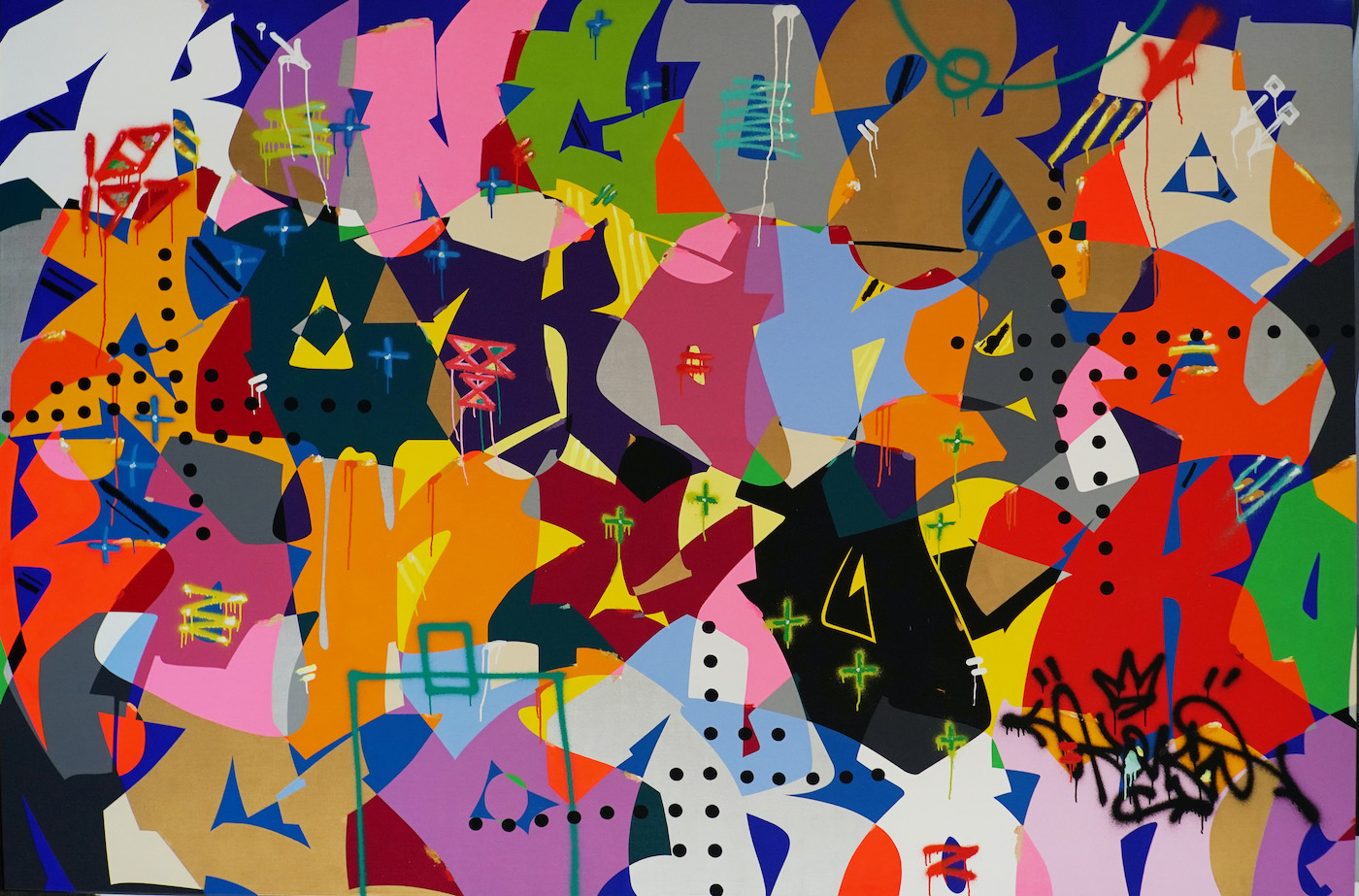
An artist’s challenges and vulnerabilities as a cultural worker provided reasons that led Ika to complete her work; new and fresh motivations. The work Puzzle of Invalidities shows this, how leftovers of a wallpaper are arranged in such a way as to make an abstract-looking composition. The work was composed based on Ika’s endurance and the projection of certain parties’ denial to the challenges of cultural and creative workers. Taste, affection, creativity, and skills are often understood as something taken for granted; something that doesn’t seem to require hard work to achieve it. They are not valued as they should be in the creative labor world.
The pieces of the wallpaper were concrete manifestations of the doubts that she experienced. These were also concrete manifestations of anger, sadness, anxiety, and insecurity, which were then piled into a random and binding composition.
The materialization of this work may have seemed arbitrary at a glance, but we could still see the rhythm and order in it, reflecting how Ika was able to anchor all the accumulated negative feelings that she experienced. This work may have also stimulated feelings of brokenness but at the same time it emanated relief. Instead of exhibiting a victory over a battle, Puzzle of Invalidities revealed an accumulation of defeats. This work was an end result that provided Ika with consolation and closure to face her next exploitative situations.
Rega and Assertive Lines
Rega Ayunda Putri is an artist who graduated from a sculpture studio and is very attracted to a more direct, close, and tangible expression that is typical of the drawing medium. Rega hones her drawing skills and sensitivity whenever she works to create illustrations, especially musical illustrations. These illustrations of her are dominated by bizarre, surrealist, and distorted figures. Through her drawings, Rega seems to express a celebration of the body, leading her to a vision to see it more closely. The proximateness and directness of the drawing process allows her to be momentarily distracted by the things around her hands, such as the layers of epidermis which are parallelograms sticking to one another—she replicates the skin’s curved textures into her imageries.
A reflective vision of the body and its repetitive processes leads Rega to existential and transcendental impacts. The repetitive process of drawing microscopic body parts brings her to an appreciation over the microcosm; that all things turn out to be one and the same, and are interconnected through small and large boundaries that are both infinite. The depiction of such microscopic cross-section of the body doesn’t mean the end of the microcosm, but instead marks the human limitations to understand the world and everything in it.
In this exhibition, the practice of drawing using easily accessible media, depicting seemingly trivial things, led Rega to find new sources for her themes. For the past few years she has been interested in rotten food that she first found in her home refrigerator. Rotten foods have an interesting visual quality, often there’s no close resemblance to their original appearance when they are fresh. The visual sensation ignited Rega’s imagination of abstract and universal forms, which could represent anything in this world. Rotten foods, once again, led Rega to an existential understanding; these are part of the life cycle process. In this cycle, energy never runs out but only moves and transforms to give a next creature a chance to live.
Rega also drew with a recreational motivation, to have a respite from her other creative works. When she was a student of a sculpture studio, drawing became a real consolation as sculpture was fairly removed from something tactile and direct. As she became a creative worker, drawing filled her emotions and affection back after being drained while working.
It is undeniable that drawing is tiring. Therefore, Rega never sets a definitive target for a final result. She rather enjoys the process, line by line. When one line is finished, she feels like she always asks herself to connect it to another end of line, continuously albeit slowly. As she starts to scratch off with a pencil or pen on paper, it is like breaking the ice that surrounds her, the ice that comes from uncomfortable situations she faces in the world of creative work. By getting into the life of a drawing, she transforms unspeakable anxiety into delicate lines. She feels empowered through repeated pencil strokes that lead her to assertive emotions. Far from feeling bored and tired, the drawing experience brings Rega closer to assertive emotions: the concreteness of experience and emotions that equip her with a voice to face reality outside the drawing world.
Artistic Practice as Labor
Ika Vantiani’s and Rega Ayundya Putri’s artworks showed that the materialistic, repetitive, tactile, and artistic aspects had recreational and liberating powers. Faith in the process also enabled both artists to survive negative emotions.
However, their works also revealed the lack of common understanding about exploitations of artistic and creative workers in Indonesia. Due to consequences of individuality, they had to struggle to heal themselves from the harmful psychological effects that they suffered as a result of stressful work systems.
Ika’s and Rega’s creative processes showed us how vulnerable the existence of art workers in Indonesia is, not to mention within the context of gender and class. The neoliberal economic system contributes to this vulnerability of their existence. In addition to exploiting passion, neoliberalism can instill an awareness that art workers’ depression and emotional suffering are a worthy consequence of their personal choice to become artists and art workers. Yet, at the same time, neoliberalism can also multiply the profit of a capital owner who exploits the economic values of an art object created by an artist or emotive works of art workers contributing to cultural products.
The exhibition “Fragment by Fragment” is based on the idea of placing an artist’s artistic practice as labor. Turning such a practice into labor, in a way, reduces the degree of an artist’s autonomy. However, calling it as labor can also open up opportunities for artists and art workers to place themselves more concretely in social situations. Understanding labor paradigm means understanding the need for a real reciprocity of our work, for ourselves and others; understanding our physical and emotional limitations as humans. And to be able to do so can raise a more critical cultural agency in situations of our everyday lives.
Chabib Duta Hapsoro
Exhbition curator