NALURI: A Solo Exhibition by Tuyuloveme
TEXT BY ZARANI RISJAD PHOTOS BY KEMAL YUSUF
Tuyuloveme is a prominent Indonesian graffiti artist based in Jogjakarta with a 16 year-long practice that ranges from lettering to street art. He is an advocate of graffiti as an artistic discipline and has participated in numerous events and exhibitions in Indonesia, Australia, Singapore, Thailand, Cambodia, Russia, Philippines and the United States.
The name Tuyuloveme is a playful twist on the question, “Do you love me?” It is also a reference to the tuyul, a mythological boy that is popular in South East Asian folklore. What characterises the tuyul varies across cultures but the underlying trait that is commonly shared is his playfulness and propensity to misbehave. In almost every one of Tuyuloveme’s artwork, he appears cheeky and mischievous yet shy, never showing his face. It is reminiscent of the graffiti artist who maintains his anonymity by keeping out of the public eye despite such high-visibility work.
Tuyuloveme’s use of the tuyul has evolved over the years, initially appearing as a brazen figure with a beanie, bandana mask and spray can in hand to more recently, appearing only as a pair of eyes that peek through the artist’s brush strokes. The reduction of the tuyul to a pair of eyes signifies an evolution in Tuyuloveme’s studio practice. New work developed in the studio are increasingly abstract and less figurative. Graphic elements are stripped down yet refined with details such as gradient, pattern, layering and texture. These intricacies indicate a careful and deliberate preparation that departs from his art in the street which is spontaneous in creation and fleeting in nature.
In his latest exhibition Naluri (meaning ‘instinct’ in Bahasa Indonesia), Tuyuloveme uses his past graffiti writing experience to recreate an immersive world for the audience to explore and momentarily embody the instinct of a graffiti writer in relationship with his playing field that is the city. This reimagined landscape is a new visual language of the artist who assembles rusted and decrepit objects scavenged from the junkyard and embellishes them with dynamic paintings to reflect the way in which street art intersects with elements found in the urban environment.
The installation ‘Fear and Love’ invites the audience to walk over a bed of gravel and get up close to a pair of large compositions comprised of corrugated steel, concrete slabs, rolling metal shutters, chain link fences and Javanese teak shutters that are marked with iridescent hues and propped by sections of a railway track. It alludes to an experience of trespassing on a train depot. Trespassing is central to the practice of graffiti that requires an instinct that Tuyuloveme has refined and skills of stealth and cunning he has honed. As a graffiti writer, he perceives the urban environment in a different manner, scanning for potential locations to be embellished. This process is known as the ‘writer’s gaze’. The aerosol stars that are frequently featured in Tuyuloveme’s works represent the city’s gleaming virgin surfaces that beg for his creative attention.
‘Random Encounters’ are a series of oddly shaped canvas artworks which highlight the challenge of putting up pieces in unpredictable less than ideal spaces. According to Tuyuloveme, graffiti is an organised and well-thought out activity. Once a location is targeted, what usually follows is a repertoire of solutions to logistical challenges involved in putting up the artwork. No amount of challenges can get in the way of finding the perfect space. A vital concept in graffiti, pride of place is further represented in ‘Getting Up’: a wall mounted composition that joins rusted metal with polished cement, then painted over with Tuyuloveme’s colourful artwork. A scavenged ladder mounted on top finishes the piece to symbolise the act of climbing a ladder and holding on while painting with one’s other hand. The title references the graffiti term ‘get up’ in which a graffiti writer gains respect by painting an elaborate piece in a difficult location.
The centerpiece of Naluri is the ‘Dance of Joy,’ a stand-alone sculpture depicting a section of graffiti-emblazoned wall, surrounded by a twisted and gnarled chain link fence on which a ‘private property’ plaque is mounted. The ‘Dance of Joy’ refers to the action of squeezing into tight spaces, ducking into holes in walls or fences and other similar movements needed to enter a space illegally.
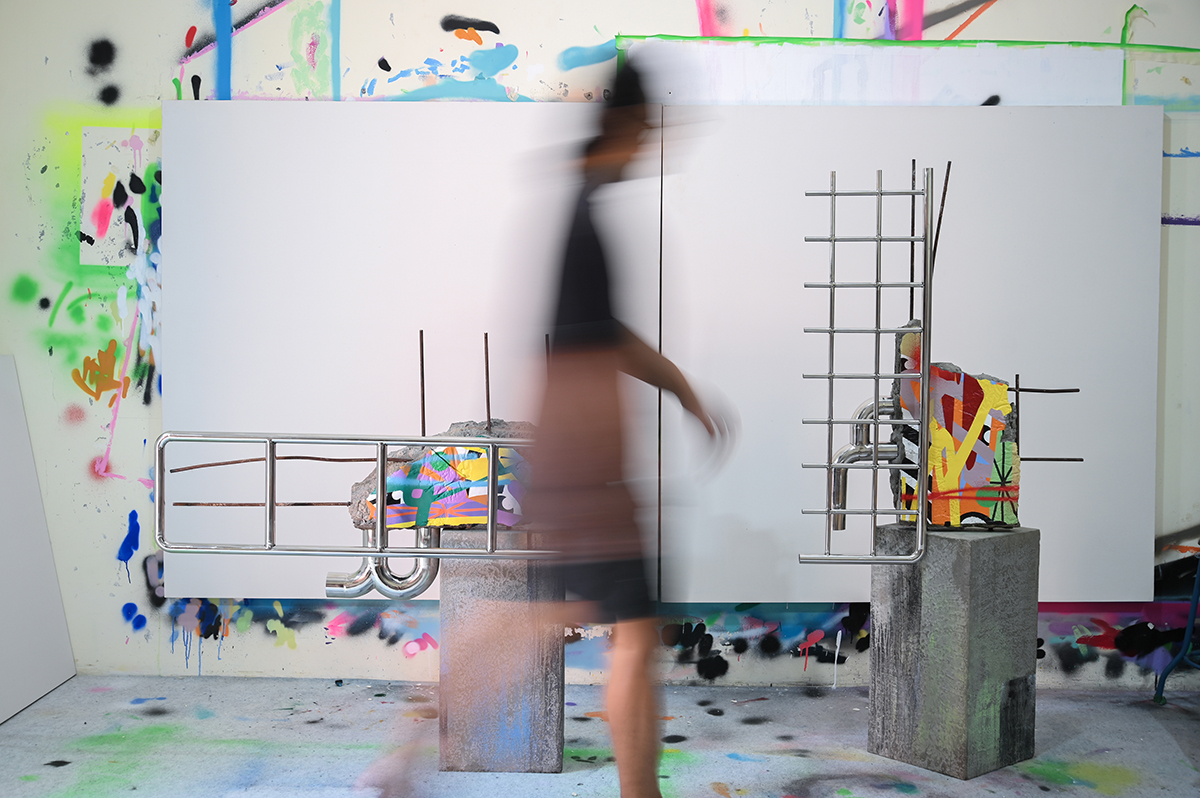
‘Piece by Piece’ is a pair of sculptures that are an assemblage of scrapped parts i.e. corners of stainless steel exhaust pipes, truck ladders, grill guards and steel reinforcing rods inserted in concrete fragments, the latter embellished with the iridescent aerosol hues of Tuyuloveme’s artwork. They form a sophisticated and elegant composition highlighting the unexpected beauty that can be found even in a derelict urban landscape.
Naluri is a window into what is usually an obscured view of the experience of graffiti: the pride, the pleasure and the effort involved in completing a piece. There is also a sense of the powerful visceral experience that occurs upon seeing the word or image take shape, further charged by the illicit nature of the activity. Graffiti is a paradox. It is both an aesthetic practice as well as a criminal activity. Nevertheless, the artist celebrates its cultural value and advocates its visual merit.
But what is the motivation of the graffiti writer and why is the phenomenon celebrated? Tuyuloveme suggests that graffiti gives the writer a sense of pleasure, a result of the writer’s strong connection to the city. This connection is described by criminology researchers Halsey and Young:
In the act of writing—that is, by using the aerosol can and the felt tip marker as key prosthetics for connecting ‘self’ and ‘world’ (but also as a means of collapsing such distinctions)—graffiti writers connect themselves to all the possible reactions the city can muster with respect to a particular image or set of images produced over time. (Halsey & Young, 2006, p. 278)
This connection extends beyond the city’s landscape to its inhabitants who derive a sense of pleasure from the chance encounter of artworks in urban public spaces. For the graffiti writer, this reciprocity forges a sense of belonging – to other people and places. Tuyuloveme explains that his career has been nourished and influenced by travelling and collaborating with other artists. Graffiti has given him a sense of belonging, one that transcends country, language and culture.
Naluri is a culmination of eight years of Tuyuloveme’s travels around the world, learning from various artists, employing diverse techniques and drawing from different cultures. It is a process that he likens to artist residencies. Tuyuloveme is not only inspired by the streets, but also ‘lives and breathes’ them through his creative practice.
It was crucial for Tuyuloveme to be able to exhibit his works in a gallery without losing the essential aspects of his practice. The challenge of Naluri was to reach a different audience but not completely decontextualise the artwork. When the idea of this exhibition arose, the vital question for the artist was – how can he present his street art in a gallery space without losing the ethos of his practice?
Naluri is both a tribute to and a rumination of ‘street’: as a place, a genre, and an aesthetic. By using the visual language of the street, the audience is invited to witness the unexpected beauty in urban decay and the street artist paying tribute to the textures that unfold within the landscape. The use of canvas or its display in a gallery should not disqualify an artwork from being deemed street art. In Naluri, we are still able to recognise its ‘streetness’. Thus, ‘street’ is both a genre and an aesthetic.
For Tuyuloveme, this exhibition is a way to express his passion for this multi-faceted subculture. The most important aspect of this exhibition, he maintains, is its impact. The artist looks forward to starting a dialogue between street artists and contemporary art practitioners. He is hopeful that it will initiate important debate around street art and challenge entrenched notions of what art is.